
Cabinet Refacing: What It Includes, What It Costs, and When It Makes Sense
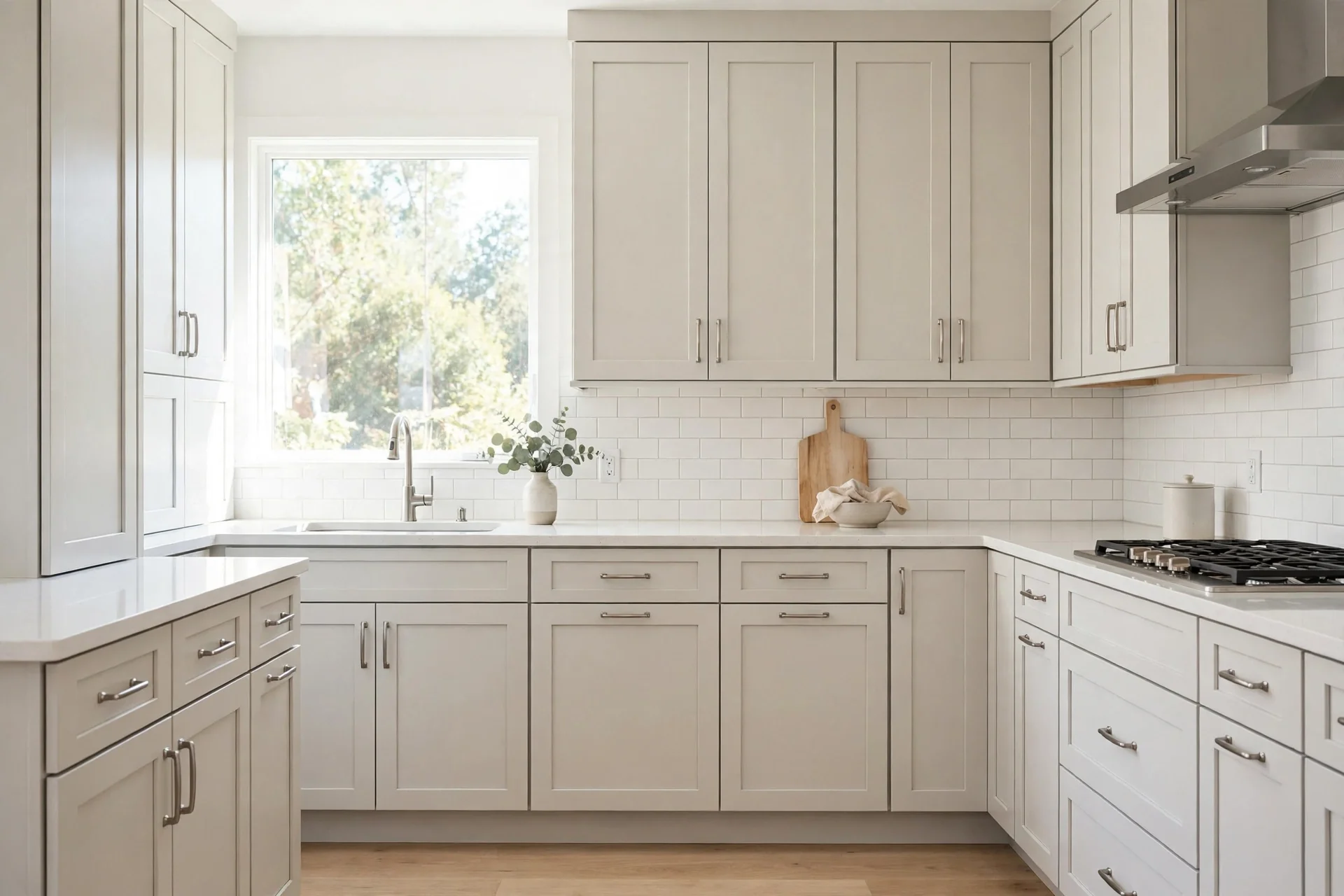
Cabinet refacing replaces the parts of your cabinets you see and touch (the doors, the drawer fronts, and the surfaces around them) while the cabinet boxes stay where they are. This Old House puts the savings at roughly 30% to 50% compared with new cabinets, and homeowners who hire a pro typically pay about $4,500 to $13,000 in the U.S. The work usually takes a few days in your home, but ordering the doors adds weeks before it starts.
Refacing works well when your layout is fine and the boxes are in good shape. It can’t fix a layout that doesn’t work, and it isn’t a good fit for damaged cabinets. The sections below cover what’s included, how the process goes, what affects the price, how cabinet refacing compares with painting and replacing, and what to ask before you sign a quote.
What cabinet refacing includes
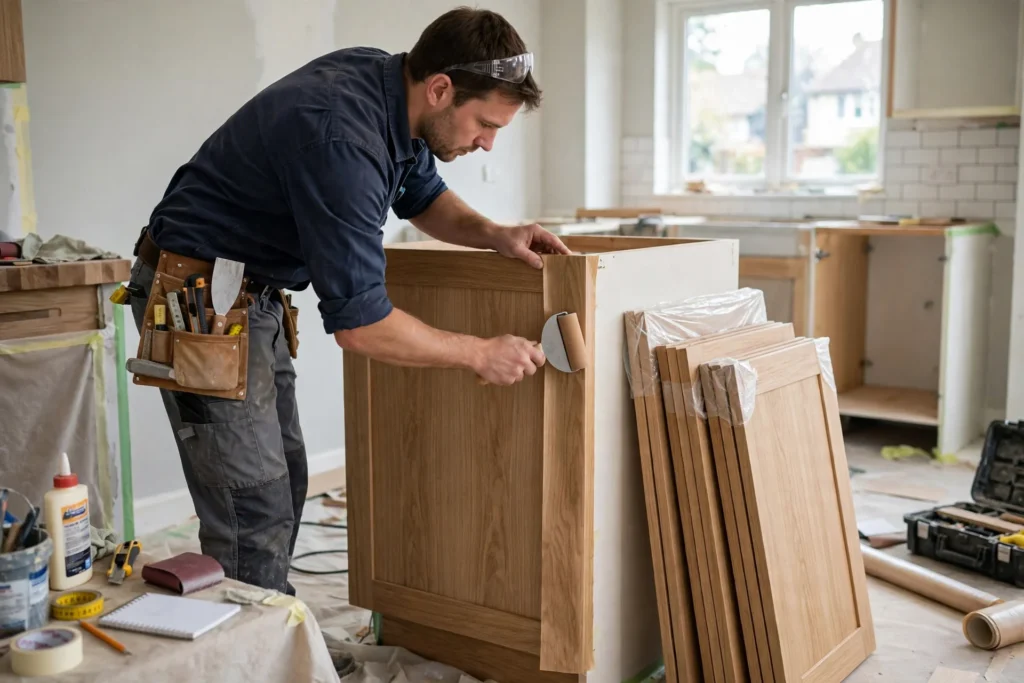
Most cabinets have a wood frame across the front of the box, called the face frame. Cabinet refacing covers that frame and the exposed sides of the boxes with a thin layer of new material, then swaps in new doors and drawer fronts. This Old House describes the veneer going on in strips that copy the frame’s vertical and horizontal pieces, then being glued, bonded, and trimmed to fit.
| What changes | What stays |
|---|---|
| Doors and drawer fronts | The cabinet boxes and where they sit |
| Veneer, laminate, or thermofoil over exposed face frames and end panels | The layout and the number of cabinets |
| Hinges and pulls, usually | Your countertops |
| Optional trim or molding | Plumbing and appliances, typically |
That last column matters. Refacing doesn’t do anything for dated countertops, so some homeowners replace those at the same time, which This Old House says can add several thousand dollars.
How the process works
- Measuring and choosing. The installer measures every door, drawer front, and exposed surface, checks the condition of the boxes, and you pick a style, finish, and hardware.
- Ordering. The doors and drawer fronts are made to order, usually matched to the veneer. This is often the longest wait.
- Removal. Old doors, drawer fronts, and hardware come off.
- Cleaning. The surfaces get a degreaser so the adhesive bonds properly.
- Veneering. New material goes onto the face frames and exposed sides, then gets trimmed and the edges are sanded smooth.
- Installation. New doors, drawer fronts, and hardware go on and get adjusted so the gaps are even.
On timing, cabinet refacing companies commonly quote three to five days in your home for a standard kitchen, with a larger kitchen or a detailed door style adding a day or two. One refacing franchise says ordering and production usually take two to six weeks or more, and that the whole project runs three to eight weeks from the first consultation. Those figures come from companies that sell refacing, so treat them as typical rather than guaranteed, and ask for your dates in writing.
Materials: veneer, thermofoil, laminate, and solid wood
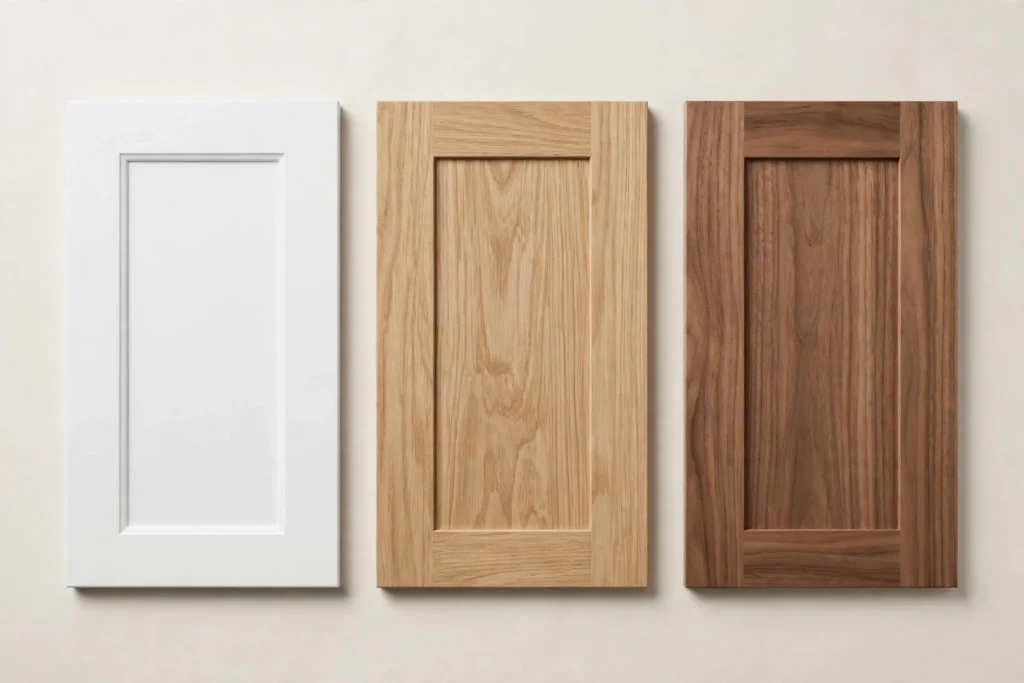
The surface material is the biggest driver of price. Fixr lists rigid thermofoil (RTF) as the most common choice, with real wood veneer costing about twice as much and solid wood doors at the top of the range.
| Material | Typical cost per linear foot of cabinet |
|---|---|
| Rigid thermofoil (RTF) | $80 to $120 |
| Wood veneer | $100 to $250 |
| Solid wood | $200 to $500 |
These are estimates from one cost guide and include materials and labor. HomeGuide, a second guide, gives a similar low end of $80 to $125 per linear foot for laminate or thermofoil and about $500 for solid wood.
If you’re looking at DIY kits, real wood veneer is sold in sheets, and Hunker notes the veneer, doors, and drawer fronts are typically sold together so the wood and finish match.
What cabinet refacing costs
Angi’s 2025 data puts the average U.S. project at $7,229, with most falling between $4,233 and $10,224, or roughly $150 to $450 per linear foot. HomeGuide lists $5,000 to $13,000 for an average kitchen. This Old House says homeowners who do it themselves can expect to spend about $1,000 to $4,000 on materials and tools, and $4,500 to $13,000 to hire it out.
Canadian prices are different. One Canadian cost guide estimates $2,500 to $8,500 for an average kitchen including installation, though it doesn’t clearly state the currency, so treat that as a rough guide only.
What moves the price:
- Number of cabinets. More doors, drawer fronts, and exposed surfaces mean more material and more labor hours.
- Material. See the table above.
- Hardware. Angi lists $100 to $1,000 for replacement hardware.
- Extras. HomeAdvisor lists crown molding at about $7 to $16 per linear foot, glass inserts at $100 to $300 per linear foot, and under-cabinet lighting at $200 to $300 per light.
- Countertops. They’re a separate project and a separate cost.
Refacing, painting, and replacing compared
| Option | What it does | Typical U.S. cost | Can it change the layout? |
|---|---|---|---|
| Refinishing or painting | Keeps your doors and boxes, changes the surface | About $1,745 to $4,000 (HomeAdvisor data via HomeLight) | No |
| Refacing | New doors and drawer fronts, new surface on the frames | About $4,500 to $13,000 hired out (This Old House) | No |
| Replacing | New cabinets, new boxes | About $4,500 to $15,000 or more (HomeGuide) | Yes |
The ranges overlap, especially when cabinet refacing uses real wood. If you’re comparing close numbers, get quotes for both options. We compare cabinet refacing with painting and with replacement in separate articles.
When refacing makes sense, and when it doesn’t
Refacing is a good fit when you like your kitchen’s layout, the boxes are structurally sound, and you want a new style without a major renovation. It’s also less disruptive than replacing, since the boxes, countertops, and plumbing typically stay put and the kitchen remains largely usable.
It’s the wrong choice in a few situations:
- The layout doesn’t work. If you want to move cabinets, add storage, or change the flow, refacing won’t do it.
- The cabinets are damaged. This Old House says damaged cabinets aren’t good candidates because the boxes must be structurally sound. Open the doors and look inside, especially under the sink, for soft, swollen, or crumbling panels.
- You’re not happy with the countertops or other fixed features. Refacing leaves them as they are.
DIY or hire a pro?
This Old House calls cabinet refacing a project that takes patience and attention to detail but isn’t all that difficult, and it says the face frames are the hardest part. You’ll need to cut veneer slightly oversize, apply adhesive, roll out air bubbles, trim the overhang, and sand the edges, and any mistakes show on the most visible surfaces. Tools range from a utility knife and veneer roller to a drill and a hardware jig.
A professional gets you a measured, matched set of doors and a finish crew, and some companies offer a warranty. DIY saves labor cost, but it takes more time than a crew would, and a visible mistake is harder to hide than on a painted surface.
How long refaced cabinets last
This Old House says refaced cabinets should last 10 to 20 years with minimal maintenance, as long as you keep them clean and touch them up when needed. How long yours last depends on the materials, the condition of the boxes, and the quality of the installation.
What to ask when you compare quotes
Two quotes with the same total can cover very different work. Ask each company:
- What material covers the face frames and end panels, and how thick is it?
- Which hinge and drawer slide brands are included, and is soft-close standard or an upgrade?
- Are the doors finished in a shop or on site?
- Are drawer boxes, trim, hardware, and removal of the old doors included?
- What is the lead time for the doors, and when is the install window?
- What does the warranty cover, in writing?
A quote that lists the number of doors and drawer fronts and the price per item is easier to compare than a single lump sum.
Where to start
Before you call anyone, count your doors and drawer fronts and measure the total length of your cabinets, since pricing usually runs per linear foot or per piece. Then check the boxes for damage and decide honestly whether your layout works. If it does, get at least three itemized refacing quotes, and ask one contractor to price replacement or refinishing as well so you have something to compare.
Frequently asked questions
Q: Is cabinet refacing eco-friendly?
A: It can be. Because the boxes stay in place, much less ends up in the landfill than with a full replacement. This Old House says refacing is potentially more eco-friendly, depending on what you do with the old materials. The doors and drawer fronts are what get removed, and some companies recycle them.
Q: Can I still use my kitchen during refacing?
A: Mostly. Since the boxes, countertops, and plumbing typically stay in place, the kitchen remains largely usable. The doors and drawer fronts will be off while the work is done, so ask your installer which days the cabinets will be out of use.
2 Comments